
Table of Contents
- How Dangerous Is a Cracked Windshield, Really?
- Crack Size and Location: A Quick Safety Check
- Is It Illegal to Drive with a Cracked Windshield?
- How to Stop a Windshield Crack from Spreading
- Windshield Crack Repair vs Replacement: Which Do You Need?
- How Long Does a Windshield Repair Take?
- The Hidden Risk: ADAS Calibration After Replacement
- Your Next Step: Getting a Professional Assessment
- Frequently Asked Questions
Last Updated: September 6, 2026
How Dangerous Is a Cracked Windshield, Really?
A cracked windshield is a genuine safety hazard that compromises the structural integrity of your vehicle, not just an aesthetic annoyance. The glass provides up to 45% of the cabin’s structural strength in a frontal collision and serves as a crucial backstop for airbag deployment (nhtsa.gov).
The danger escalates quickly because a windshield crack rarely stays static. Every bump, temperature shift, and pressure change causes the crack to propagate, weakening the entire panel. Beyond visibility impairment, a compromised windshield reduces rollover protection, as a cracked panel has lost significant impact resistance.
Crack Size and Location: A Quick Safety Check
The size and location of the damage determine whether your cracked windshield is safe to drive on at all. As a general rule, any crack longer than 3 inches, damage in the driver’s direct line of sight, or a crack that reaches the edge of the glass makes the vehicle unsafe to drive (glass.org).
Here is a quick reference for assessing your situation:
|
Damage Type |
Size Limit |
Location |
Safe to Drive? |
|---|---|---|---|
|
Chip or bullseye |
Under 1 inch |
Passenger side |
Yes, but repair soon |
|
Chip or bullseye |
Under 1 inch |
Driver’s line of sight |
Caution, repair immediately |
|
Crack |
1 to 3 inches |
Center of glass |
Short trips only |
|
Crack |
Over 3 inches |
Any location |
No, replace before driving |
|
Crack |
Any length |
Reaching the edge |
No, structural risk is high |
The depth of damage matters just as much as the length. A crack that penetrates both layers of the laminated glass has destroyed the panel’s integrity, while a chip confined to the outer layer may still be repairable.
Visual Guide to Crack Types: Bullseye, Star, and Stress Cracks
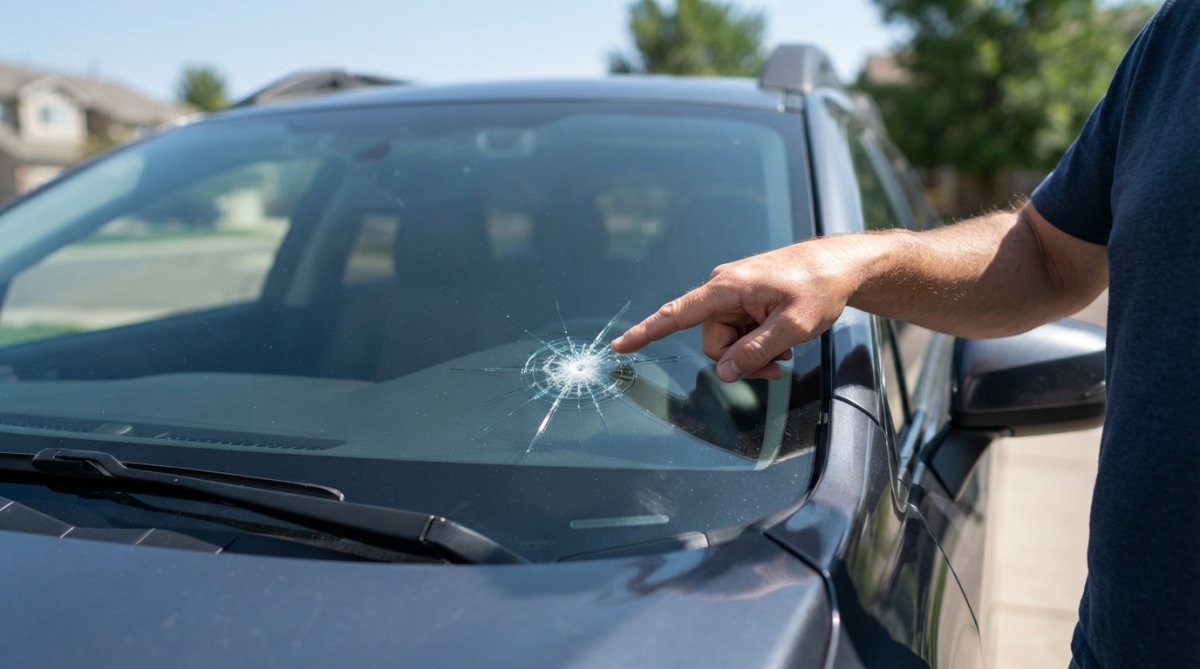
Not all windshield damage looks the same, and the crack type directly affects whether you need a windshield crack repair vs replacement. A bullseye chip appears as a circular impact point with a dark center, often caused by a small rock or stone. A star break radiates outward in multiple directions from a central impact point. A stress crack typically starts at the edge of the windshield and runs inward without any impact point, often triggered by temperature expansion or contraction.
Each type demands different action. Bullseye chips under one inch are often repairable with glass resin. Star breaks can sometimes be repaired if the legs haven’t spread too far. Stress cracks, however, almost always require a full windshield replacement because they indicate structural weakness in the glass bonding.
Is It Illegal to Drive with a Cracked Windshield?
Driving with a cracked windshield can result in a traffic citation because it violates federal regulations and most state laws regarding vehicle safety. The federal regulations require that a vehicle’s windshield provide undistorted visibility for the driver, and many state safety inspection programs will fail a vehicle with significant glass damage (ecfr.gov).
The legal risk goes beyond a simple fine. A police officer can pull you over if a crack obstructs your field of vision, and insurance companies may complicate a claim if the damage contributed to an accident. Do not wait for a citation to act.
How to Stop a Windshield Crack from Spreading
You can slow a windshield crack from spreading with immediate, temporary measures, but the only way to permanently stop it is with a professional repair or replacement. The goal of any interim step is to minimize stress on the glass and prevent contamination.
Take these steps right after you notice the damage:
- Apply clear packing tape over the entire length of the crack. This is the single most effective temporary measure because it seals the damage from water and road grime that will otherwise wick into the break and contaminate the glass, making a resin repair fail.
- Park out of direct sunlight. Temperature swings cause the glass to expand and contract. A crack in a hot windshield will propagate faster than one kept in a moderate, shaded environment.
- Avoid slamming doors. The pressure wave inside the cabin puts stress on the glass. Gentle closure reduces the chance of the crack ‘running’.
- Do not use your defroster on high heat. A sudden blast of hot air on cold glass creates thermal shock. If you need to clear fog, use a moderate setting and direct the airflow away from the damaged area.
- Schedule a professional assessment within 48 hours. Crack propagation is not linear; it accelerates as the fissure lengthens and weakens the surrounding glass structure.
The DIY Repair Kit Decision: When It’s Safe and When It’s a Trap
A common mistake is reaching for a $15 DIY repair kit to ‘fix’ a crack that has already spread. These kits are precision tools for a very narrow set of circumstances, and using them incorrectly can turn a repairable chip into a full replacement.
A DIY kit is a reasonable option ONLY if ALL of these are true:
- The damage is a chip or bullseye under 1 inch in diameter.
- The damage is not in the driver’s direct line of sight.
- The damage is not on the edge of the glass.
- There are no spider-web legs radiating from the impact point.
- You are comfortable following the resin injection and curing instructions precisely.
A DIY kit is a dangerous if ANY of these are true:
- The damage is a linear crack longer than 1 inch. The resin in DIY kits is low-viscosity and cannot fill the entire length of a long crack, leaving the structural weakness in place.
- The crack has reached the edge of the windshield. This compromises the bond between the glass and the frame, and no resin injection can restore that structural hold.
- The crack is in the driver’s line of sight. Even if the resin fills the damage, the cured resin creates a visual distortion (a ‘fisheye’) that scatters light and impairs night vision.
- The glass is laminated and the crack has penetrated the inner layer. DIY kits only treat the outer layer. If the inner layer is compromised, the structural integrity is gone.
A DIY kit on a crack longer than 1 inch creates a false sense of security. The driver sees the resin fill the gap, but the crack remains a structural weak point that can fail in a collision. The kit does not restore impact resistance; it only improves appearance temporarily.
Why Temporary Measures Fail: The Physics of Crack Propagation
A windshield crack spreads because of stress concentration at the crack tip. Every vibration, temperature change, and chassis flex applies force to that microscopic point. Tape and shade only reduce the rate of propagation; the only permanent solution is to remove the stress concentration by filling the crack with resin or removing the panel.
Windshield Crack Repair vs Replacement: Which Do You Need?
The decision between windshield crack repair vs replacement comes down to three factors: the physical characteristics of the damage, its location relative to the driver and the glass edge, and the financial consequences of your choice.
The 3-Inch Rule and the Edge Rule
A repair is viable when the damage is a chip or crack under 3 inches long, is not in the driver’s direct line of sight, and does not reach the edge of the glass. A crack that reaches the edge compromises the bond between the glass and the vehicle frame, which transfers crash forces to the roof and pillars. Once the edge is compromised, no resin repair can restore it, and a full replacement is the only safe option.
A crack longer than 3 inches, even if not at the edge, should be replaced.
The Hidden Financial Cost: Resale Value and Insurance Claims
Beyond the immediate safety risk, a cracked windshield carries a financial penalty. When you trade in or sell a vehicle, a cracked windshield is an automatic deduction on the dealer’s appraisal. A $300 replacement can reduce your trade-in value by $500 or more because the dealer accounts for labor and downtime, and a visible crack is also a bargaining chip for a private buyer.
Delaying the repair also risks your insurance claim. Most comprehensive policies cover windshield repair with a $0 deductible, meaning a chip repair costs nothing out of pocket. However, if the crack spreads beyond the repairable threshold, the replacement is often subject to your comprehensive deductible of $250, $500, or $1,000. By delaying, you convert a free repair into a deductible payment.
The Repair Process: What Resin Actually Does
A professional repair involves injecting a clear acrylic resin into the damaged area under pressure, then curing it with ultraviolet light. The resin bonds to the glass and fills the void, restoring optical clarity and preventing moisture intrusion. However, a repair does not restore the original impact resistance of the glass, which is why repairs are only recommended for small, non-structural damage.
The Replacement Process: What You Are Paying For
A replacement removes the entire panel and installs new automotive glass. The cost includes the glass, the urethane adhesive, the labor to remove the old glass and clean the frame, and the time for the adhesive to cure. On modern vehicles, it also includes the labor to disconnect and reconnect any rain sensors, antennae, or heating elements bonded to the glass.
The ADAS Calibration Cost: A Non-Negotiable Line Item
On vehicles equipped with Advanced Driver Assistance Systems, a windshield replacement is not complete when the new glass is installed. The cameras and sensors that power lane departure warning, automatic emergency braking, and adaptive cruise control are mounted on the windshield or the rearview mirror housing. Removing the old glass disrupts their factory alignment. Recalibration is required to restore their accuracy.
Skipping calibration to save $200 to $300 creates a sensor interference risk. A camera misaligned by even a fraction of a degree can cause your vehicle to brake unexpectedly or fail to detect a pedestrian. When you receive a quote for a replacement, ask explicitly whether ADAS calibration is included; if not, add that cost to your comparison.
A Decision Framework for Your Specific Damage
Use this checklist to make your decision:
|
Damage Characteristic |
Repair Viable? |
Replacement Required? |
|---|---|---|
|
Chip under 1 inch, not in line of sight |
Yes |
No |
|
Crack 1-3 inches, not at edge, not in line of sight |
Yes, if inner layer is intact |
No |
|
Crack over 3 inches |
no |
Yes |
|
Crack reaching the edge |
some |
Yes |
|
Damage in driver’s line of sight |
No (visual distortion) |
Yes |
|
Crack penetrating inner glass layer |
No |
Yes |
How Long Does a Windshield Repair Take?
A professional windshield repair typically takes 30 to 60 minutes, while a full replacement takes 60 to 90 minutes, depending on the vehicle model and adhesive curing time. The process is faster than most drivers expect, which means there is little reason to delay addressing a safety hazard.
The technician begins by cleaning the damaged area and removing any debris. For a repair, they inject resin and cure it. For a replacement, they remove the old glass, clean the frame, apply new adhesive, and install the new windshield. The vehicle should not be driven until the adhesive has cured.
A to Z Auto Glass brings this service directly to your home or workplace in Aurora and Parker, so you do not lose a full day waiting in a shop. Our technicians handle the entire process on-site with attention to detail, and we offer transparent pricing with no hidden fees.
The Hidden Risk: ADAS Calibration After Replacement
Modern vehicles equipped with Advanced Driver Assistance Systems require calibration after a windshield replacement, and skipping this step creates a serious safety risk. The cameras and sensors that power features like lane keeping, adaptive cruise control, and automatic braking are mounted on the windshield. Removing the glass disrupts their alignment.
Without proper calibration, these systems may malfunction or fail entirely. A sensor off by even a fraction of a degree could cause your vehicle to brake unexpectedly or fail to detect an obstacle. This is not a dealership-only service; many independent providers, including A to Z Auto Glass, are equipped to handle calibration.
When you schedule a windshield replacement, ask whether calibration is included or required for your specific make and model. Driving with a misaligned ADAS system is a hidden danger that many drivers do not discover until a safety feature fails.
Your Next Step: Getting a Professional Assessment
A cracked windshield is never truly safe to ignore, and the only way to know your exact risk is to have a professional technician assess the damage in person. Photographs and online advice give a general idea, but the depth of damage and the integrity of the glass bonding require hands-on inspection.
At A to Z Auto Glass, we have served Aurora and Parker for 25 years with a focus on safety and customer satisfaction. Our mobile service comes to your home or workplace, and our technicians provide a thorough inspection before recommending repair or replacement. We handle everything from simple chip repairs to full replacement with ADAS calibration.
Do not wait until a small crack becomes a safety hazard or a legal citation. Schedule an assessment with A to Z Auto Glass and get your vehicle road-ready with confidence.
Frequently Asked Questions
Can a cracked windshield collapse while driving?
A sudden, complete collapse is rare, but it is a real risk. The windshield provides up to 60% of the roof’s structural integrity in a rollover and supports the passenger-side airbag. A large crack compromises this strength. The bigger danger is that the crack will spread from road vibrations or temperature changes, causing the glass to shatter and block your field of vision. If the crack is larger than a dollar bill or in the driver’s line of sight, treat it as an urgent safety hazard and get a professional assessment before driving.
Will my insurance go up if I claim for a windshield?
A claim for windshield repair or replacement is typically filed under your comprehensive coverage, not your collision coverage. In most cases, a single comprehensive claim for glass will not cause your premiums to rise. Many policies even include zero-deductible glass coverage. However, filing multiple claims in a short period could flag you as higher risk. The best move is to call your insurance provider to confirm your specific glass coverage and deductible before scheduling service.
How do I know if my windshield needs repair or replacement?
The general rule is that chips smaller than a quarter and cracks shorter than 3 inches can often be repaired. Cracks longer than that, damage that reaches the edge of the glass, or any crack in the driver’s direct line of sight usually requires a full replacement. Structural damage that penetrates both layers of the laminated glass also demands a replacement. A professional technician can make the final call, as they will assess the depth of damage and crack type to determine if the glass bonding is still sound.
What happens if you drive a car with a cracked windshield?
Several things can go wrong. The crack can spread quickly due to road vibrations, temperature expansion, or even a minor pothole, turning a small repair into a costly replacement. Your visibility can be impaired, especially at night or in bright sun when light reflects off the damage. You also risk a traffic citation in many states where a cracked windshield is a legal violation. Finally, you compromise your vehicle’s safety: the glass is weaker in an accident, reducing rollover protection and potentially interfering with airbag deployment.