
Table of Contents
- The Mobile Windshield Replacement Timeline: What to Expect
- What Happens During a Mobile Windshield Replacement
- Windshield Replacement Adhesive Cure Time Explained
- Safe Drive-Away Time After Windshield Replacement
- Does Insurance Cover Mobile Windshield Repair?
- ADAS Recalibration and Vehicle-Specific Factors That Add Time
- Common Mistakes to Avoid After a Mobile Windshield Replacement
- Frequently Asked Questions
Last Updated: September 11, 2026
The Mobile Windshield Replacement Timeline: What to Expect
A mobile windshield replacement typically takes 60 to 90 minutes of hands-on work, but the full timeline from arrival to safe drive-away usually runs three to four hours once adhesive curing is factored in (safeglass.org). A to Z Auto Glass has 25 years of experience providing mobile windshield repair and replacement services in Aurora and Parker. The pattern is consistent: the physical swap is quick, while the wait afterward is what catches most drivers off guard. This guide breaks down every phase, from cowl removal to ADAS recalibration, so you know exactly how to plan your day.
Here is the short version, and it is the answer most people actually need:
A mobile windshield replacement takes about 60-90 minutes of installation time, plus a minimum one-hour adhesive cure before the vehicle is safe to drive. Add 30-60 minutes if your vehicle requires ADAS camera recalibration.
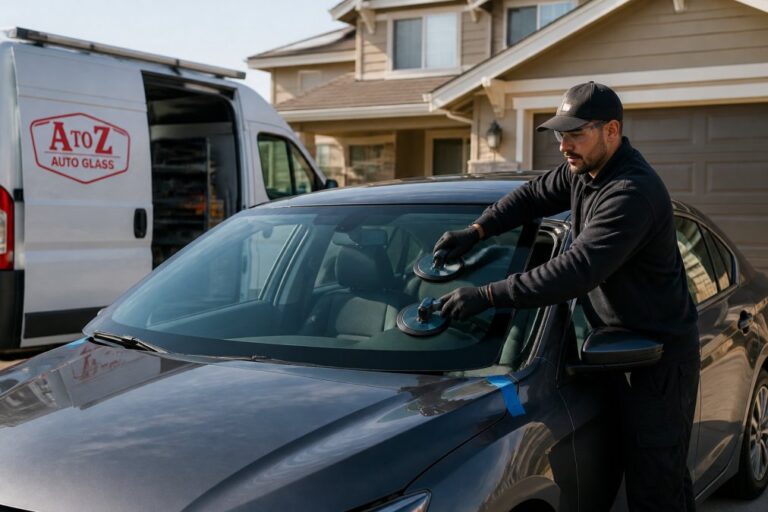
Technician carefully removing a car windshield during a mobile windshield replacement in a residential driveway.
What Happens During a Mobile Windshield Replacement
The mobile process mirrors a shop installation almost step for step, just performed in your driveway or office parking lot. The technician brings the glass, the urethane adhesive, the priming materials, and the tooling.
Cowl and Wiper Assembly Removal
The technician first removes the wiper arms and the plastic cowl panel at the base of the windshield. This exposes the adhesive bead and gives clean access to the glass edges. It is a 10-15 minute step on most vehicles, though wiper assemblies on some models are fiddlier than others.
Old Glass Removal and Surface Prep
Cutting out the old windshield takes another 15-20 minutes. The technician runs a cold knife or wire through the urethane bead, lifts the glass free, then scrapes and primes the pinch weld. A common mistake is rushing this prep. Any leftover old adhesive or skipped primer coat weakens the new bond, and that is a safety problem, not a cosmetic one.
New Glass Installation and Urethane Adhesive Application
The new glass goes in with a fresh bead of urethane adhesive, typically a high-modulus product rated for structural bonding. The technician sets the glass, checks the gap and alignment, and reinstalls the cowl and wipers. Total install: 25-35 minutes.
Windshield Replacement Adhesive Cure Time Explained
Windshield replacement adhesive cure time is the single biggest factor in how long your vehicle sits after the install finishes. Urethane adhesive does not dry like paint; it cures through a chemical reaction with moisture in the air, which is why humidity levels and temperature matter so much.
Two numbers matter here, and they are different:
- Adhesive set time: how long until the bead is firm enough to hold the glass in place, usually 30-60 minutes
- Full cure: how long until the bond reaches maximum strength, often 24 hours or more
You can drive once the adhesive reaches safe drive-away strength
lly until full cure. That means no pressure-washing the car, no slamming doors, and no off-road driving for the first day.
Safe Drive-Away Time After Windshield Replacement
Safe drive-away time after windshield replacement is the minimum wait before you can legally and safely put the vehicle in motion, and it is usually one hour with modern fast-cure urethanes. Some adhesives allow drive-away in 30 minutes; others need longer.
The variables that push this number around:
- Temperature: cold slows the cure; many adhesives need ambient temperatures above roughly 30°F to behave predictably
- Humidity: dry air extends cure time because urethane needs moisture to react
- Adhesive type: fast-cure formulations versus standard structural urethanes
- Vehicle position: parking on uneven ground can stress a partially cured bond
Does Insurance Cover Mobile Windshield Repair?
Does insurance cover mobile windshield repair? In most cases, yes, if you carry comprehensive coverage. Comprehensive policies typically handle glass damage from hazards like rocks, hail, or debris, and many insurers treat mobile service the same as a shop visit.
What the Clock Actually Measures
When someone asks how long a mobile windshield replacement takes, they are usually picturing the technician in the driveway. In reality, the full elapsed time from your first phone call to a drivable vehicle includes three separate clocks:
- The claims clock, filing the claim, getting it approved, and receiving a claim number. This can take anywhere from a few minutes online to a day or more if an adjuster needs to inspect the damage first.
- The scheduling clock, the gap between approval and the technician’s arrival. Mobile slots are often available same-day or next-day, but popular windows fill up, and some insurers route glass claims through a third-party administrator that adds a handoff step.
- The service clock, the 60-90 minutes of installation plus the adhesive cure and any recalibration, which is what the rest of this article covers.
Only the third clock is the technician’s time. The first two are administrative, and they are why two neighbors with identical damage can have very different experiences.
Practical Points That Save Time
- Some insurers waive the deductible for repair but apply it to replacement. If a chip is smaller than a dollar bill and not in the driver’s line of sight, a repair may be both faster and cheaper.
- Mobile service often costs the insurer less than a shop visit, so many carriers actively encourage it, but you may need to request it rather than accept the first shop the claims line offers.
- Have your policy number, VIN, and a photo of the damage ready before you call. Claims move faster when You have your policy number handy.
- Ask whether your insurer uses a third-party glass administrator. A to Z auto glass is a preferred provider for all major insurance companies and 3rd party administrators like Safelite Solutions and Lynx Services
ADAS Recalibration and Vehicle-Specific Factors That Add Time
ADAS recalibration is the step that separates a two-hour job from a four-hour one, and it is also the step most generic timelines ignore. If your vehicle has lane-keeping assist, adaptive cruise control, automatic emergency braking, or a forward-collision warning system, the camera mounted behind the windshield needs recalibration after replacement. The camera’s aim is set to the original glass; a new windshield, even one from the same manufacturer, can sit at a slightly different angle. Skip recalibration and those systems can misread the road, or throw a fault code that disables them entirely.
There are two recalibration types, and which one applies to your vehicle is not your choice, it is dictated by the automaker’s service procedure:
|
Recalibration Type |
How It Works |
Typical Added Time |
|---|---|---|
|
Static |
Vehicle positioned at targets in a controlled space |
30-60 minutes |
|
Dynamic |
Technician drives the vehicle at set speeds on marked roads |
20-45 minutes |
|
No ADAS |
Older vehicles without camera systems |
None |
Which Vehicles Actually Need Recalibration
A common misconception is that only high-end vehicles have camera systems. In practice, forward-facing cameras became standard on many mainstream models well before 2020. A few patterns worth knowing:
- Compact and mid-size sedans from the last several model years often carry a single forward camera for lane departure warning and automatic high beams. These usually need a dynamic recalibration, which is faster but requires the technician to drive the vehicle.
- Crossovers and SUVs frequently combine a forward camera with radar behind the grille and sensors in the bumper. These often require a static recalibration with target boards, which needs flat, level ground and roughly 10-20 feet of clear space in front of the vehicle.
- Luxury and sensor-heavy models may run a camera plus radar plus lidar, and some require both a static and a dynamic pass. That combination is where a job stretches past the three-hour mark.
- Acoustic glass and rain sensors add handling time but not recalibration time. The technician has to transfer or replace the sensor, and the glass itself costs more, but the calibration step is unchanged.
Common Mistakes to Avoid After a Mobile Windshield Replacement
The most common post-replacement mistakes all come down to treating the vehicle normally too soon. The bond is still curing even after you drive away.
- Slamming doors in the first 24 hours, which can shift the glass before full cure
- Running through a car wash too early; high-pressure water can compromise a fresh seal
- Parking on a steep slope overnight, which stresses a partially cured bond
- Removing the tape the technician applied to hold trim or molding in place
One more thing worth planning for: mobile service logistics. A technician working in your driveway needs roughly the same footprint as a parking space, plus room to open doors and set tools. If you are booking at a workplace, confirm the parking situation in advance. And if you are wondering whether we actually show up when we say we will, that is a fair question. A to Z Auto Glass has served the area for 25 years, and our booking confirms your arrival window up front so you are not burning a day off waiting.
A cracked windshield rarely waits for a convenient moment, and the uncertainty around timing makes it worse. A to Z Auto Glass removes that guesswork with free on-site mobile service, transparent pricing with no hidden fees, and a team that has handled glass replacement for 25 years. We come to your home or workplace, walk you through the cure window, and leave your vehicle road-ready. Schedule now with A to Z Auto Glass and get your windshield handled without losing your day.
Frequently Asked Questions
How long can I drive after getting my windshield replaced?
Safe drive-away time depends on the urethane adhesive used. Most modern adhesives allow driving in about one hour if the vehicle is kept at moderate speeds and away from rough roads. Cold or humid weather can extend that window. Your technician will tell you the exact safe drive-away time for your vehicle before leaving.
Does insurance cover mobile windshield repair?
Many auto insurance policies cover mobile windshield repair or replacement, especially if you carry comprehensive coverage. Some insurers waive the deductible for repairs but not replacements. Coverage varies by state and policy, so call your insurer before scheduling.
Is it safe to have a windshield replaced in my driveway?
Yes. Mobile windshield replacement is safe when the technician has enough space around the vehicle. Wind, direct sun, and extreme temperatures can affect adhesive curing, so a garage or covered driveway is ideal. If weather is a problem, the technician may suggest rescheduling.
What factors affect the time required for mobile glass replacement?
Vehicle make and model, windshield size, rust or damage around the frame, ADAS camera recalibration requirements, and weather all affect how long the job takes. A simple sedan replacement may finish in under an hour, while a vehicle with lane-assist cameras can take longer because calibration is needed after the glass is set.