
Table of Contents
- What Mobile ADAS Calibration Service Includes
- When Is ADAS Recalibration Needed After Glass Work?
- How Long Does ADAS Calibration Take On-Site?
- ADAS Calibration Cost: What Factors Set the Price
- Mobile vs. In-Shop Calibration: Accuracy and Convenience
- DIY Risks and Why OEM Specifications Matter
- How to Schedule Your Mobile Calibration
- Step 1: Gather Your Vehicle Information
- Step 2: Confirm the Scope of Work
- Step 3: Prepare Your Location
- Step 4: Plan for the Time Commitment
- Frequently Asked QuestionsIs mobile ADAS calibration as accurate as in-shop calibration?
- When is an ADAS recalibration required after windshield replacement?
- What affects ADAS calibration cost for mobile service?
- Can you recalibrate my lane assist camera after a windshield replacement?
- Frequently Asked Questions
Last Updated: September 8, 2026
What Mobile ADAS Calibration Service Includes
Advanced driver-assistance systems, or ADAS, rely on cameras and radar sensors to handle tasks like lane keeping, automatic braking, and blind spot alerts. When a windshield is replaced, these components are often disturbed, and a mobile ADAS calibration service near me realigns them to factory specifications. This service uses specialized targets and diagnostic software to restore sensor accuracy, ensuring your vehicle’s safety systems respond correctly on the road.
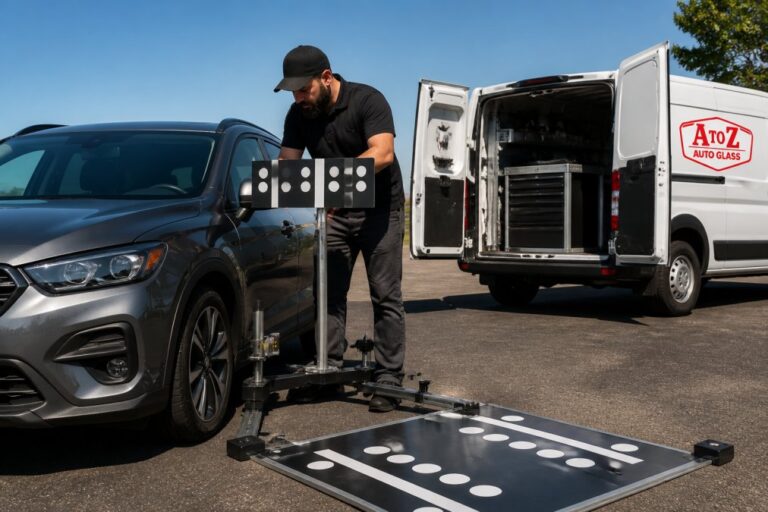
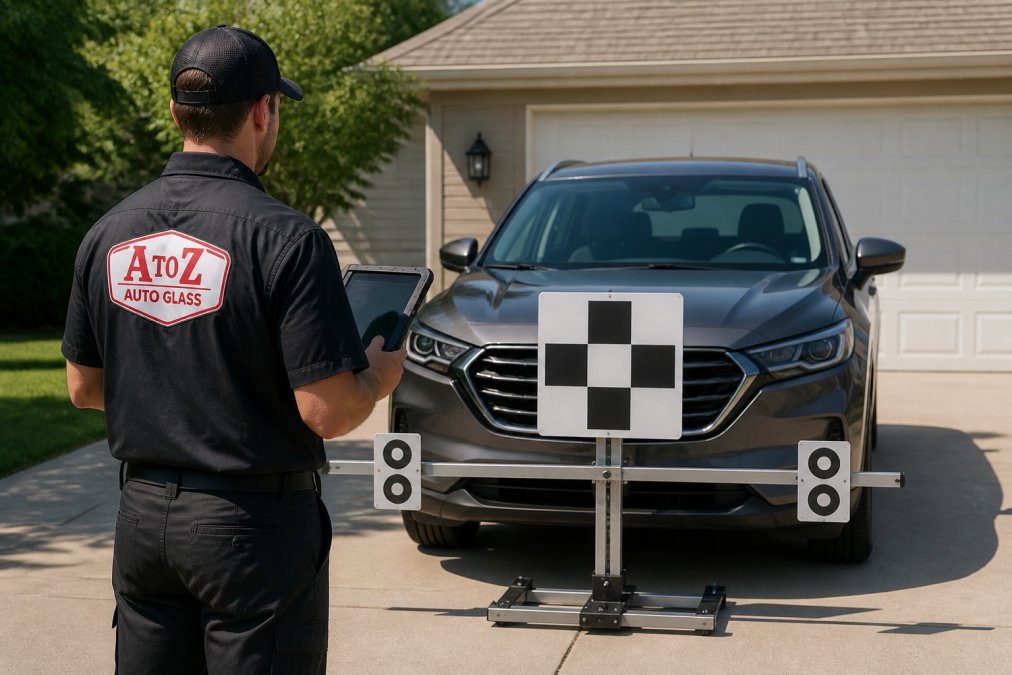
At A to Z Auto Glass, our mobile calibration process brings the equipment directly to your driveway or workplace. A certified technician mounts calibration targets in front of the vehicle, connects a diagnostic tool, and guides the system through its alignment procedure. The goal is precision: even a fraction of an inch off can cause a camera to misread the road, which is why OEM specifications guide every step of the process.
When Is ADAS Recalibration Needed After Glass Work?
Recalibration is needed whenever a windshield is replaced, because removing the glass can shift the camera mount or alter the angle at which sensors view the road. It is also required after a collision, a bumper replacement, or any repair that affects the vehicle’s ride height or alignment. Many drivers assume a new windshield is enough, but without recalibration, features like lane departure warning and adaptive cruise control may function incorrectly or not at all.
Signs that recalibration is overdue include a warning light on the dashboard, a system that engages at the wrong time, or a camera that appears misaligned after glass work. The question of when is ADAS recalibration needed comes down to one rule: any time a sensor or its mounting surface has been disturbed. Post-repair verification is not optional, it is a safety requirement that protects both the driver and everyone else on the road.
How Long Does ADAS Calibration Take On-Site?
A typical mobile calibration session takes between 20 minutes and1 hour, depending on the vehicle’s make, model, and the type of system being recalibrated (iihs.org). The answer to how long does ADAS calibration take is not a single number, because some vehicles require a simple camera recalibration, while others need radar sensors, electronic control units, or multiple modules updated in sequence. Windshield replacement itself adds time, so plan for a combined service window of roughly two to three hours.
Same-day turnaround is common with mobile providers, since they eliminate the need to transport the vehicle to a shop. For busy professionals, this means the work can happen during a lunch break or while the car sits in a workplace parking lot. The technician handles the full process on-site, from sensor initialization to the final verification drive, so you are not left waiting days for a dealership appointment.
|
Service Step |
Typical Duration |
Notes |
|---|---|---|
|
Windshield replacement |
60-90 minutes |
Includes adhesive curing time |
|
Static calibration |
15-45 minutes |
Uses fixed targets, done on-site |
|
Dynamic calibration |
20-30 minutes |
Requires a road test drive |
|
Full system verification |
10 minutes |
Confirms all modules respond correctly |
ADAS Calibration Cost: What Factors Set the Price
The ADAS calibration cost depends on several variables, and no honest provider quotes a flat rate without first identifying your vehicle. Factors that influence pricing include the number of systems that need calibration, whether the work requires static or dynamic methods, and the specific OEM specifications for your car’s brand. Luxury vehicles with multiple cameras and radar units generally cost more to calibrate than basic models with a single forward camera.
Insurance coverage can offset much of this expense, particularly when recalibration is tied to a covered windshield replacement or collision repair. Many policies treat calibration as part of the repair claim, so check with your provider before paying out of pocket. A to Z Auto Glass offers transparent pricing with no hidden fees, and a quick consultation will give you an accurate figure based on your exact vehicle and its requirements.
Mobile vs. In-Shop Calibration: Accuracy and Convenience
Mobile calibration services deliver the same precision as in-shop work, provided the technician follows OEM specifications and uses the correct targets for your vehicle. The main difference comes down to environment: a shop offers a controlled, level surface, while mobile service requires a flat, unobstructed area at your location. In practice, a driveway or empty parking lot works well, and the convenience of on-site service often outweighs the minor setup considerations.
For drivers in Aurora and Parker, mobile vs. in-shop calibration is usually decided by schedule. Mobile service eliminates the need to take a full day off work or arrange a second vehicle, which is why many commuters and busy parents choose it. The equipment used is identical to what a dealership uses, and certified technicians handle everything from sensor alignment to vehicle module programming on the spot.
DIY Risks and Why OEM Specifications Matter
Attempting a DIY calibration is risky, because the process requires specialized targets, proprietary software, and a deep understanding of each manufacturer’s requirements. Without the correct setup, the system may report success while still being misaligned, giving you a false sense of security. The diagnostic trouble codes that indicate proper alignment are not something a standard OBD-II scanner can interpret, and the tools used by professionals cost thousands of dollars.
OEM specifications exist for a reason: each automaker defines exact tolerances for camera height, sensor angle, and electronic control unit settings (nhtsa.gov). A to Z Auto Glass has 25 years of experience working with these requirements. When you trust a professional, you get post-repair verification that confirms every safety system is working as designed.
How to Schedule Your Mobile Calibration
Scheduling a mobile ADAS calibration service near me is not as simple as picking a time slot. The technician needs to know exactly what they are walking into, and you need to prepare your vehicle and your location so the calibration can actually be completed in one visit. Here is what the process looks like from your side.
Step 1: Gather Your Vehicle Information
Before you call, have your vehicle identification number (VIN) ready. The VIN tells the technician which ADAS systems your car has, what calibration procedure the OEM requires, and whether the work is static, dynamic, or both. You can find the VIN on the driver’s side dashboard near the windshield or on the driver’s side door jamb sticker. Having this number ready means the shop can give you an accurate quote and confirm they have the right targets and software on hand.
Step 2: Confirm the Scope of Work
Tell the scheduler exactly what happened to your vehicle. Was it a windshield replacement? A collision repair? A bumper replacement? Each scenario triggers different calibration requirements. A windshield replacement might only require a forward camera calibration, while a front-end collision could require camera, radar, and side sensor alignment. The more detail you provide, the better the technician can prepare.
Step 3: Prepare Your Location
Mobile calibration requires a specific environment. The technician needs a flat, level surface, or slight slope. You also need enough open space in front of the vehicle for the target frame, typically 10 to 20 feet of clear area. A driveway that is level and free of clutter works well. A vary sloped street or a tight parking garage does not.
If the calibration requires a dynamic procedure, the technician will need access to a quiet road where they can drive at highway speeds without heavy traffic. Let the scheduler know if your neighborhood has busy streets, so they can plan the drive portion of the service accordingly.
Step 4: Plan for the Time Commitment
A mobile calibration visit is not a quick drop-off. The technician needs 20 to 30 minutes for a standard static calibration, and longer if multiple systems are involved. If you are also having a windshield replaced, plan for a combined window of two to three hours. Schedule the service when you can be available to answer questions and provide access to the vehicle, but not when you need the car for an urgent errand.
Frequently Asked QuestionsIs mobile ADAS calibration as accurate as in-shop calibration?
Yes, when performed correctly. Professional mobile technicians use the same OEM-approved calibration targets, electronic control unit software, and diagnostic tools found in a shop. The key is a controlled environment: level ground, proper lighting, and enough space for the targets. A certified technician following OEM specifications achieves the same precision alignment on-site as they would in a fixed facility. Always confirm the provider uses OEM software and targets for your vehicle’s make and model.
When is an ADAS recalibration required after windshield replacement?
Recalibration is required whenever a windshield is replaced on a vehicle with advanced driver-assistance systems. The camera or radar sensor is typically mounted to the glass or the area around it. Removing the old glass shifts the sensor’s position, even by a fraction of an inch. This misalignment can disable or misdirect features like lane departure warning, blind spot monitoring, and adaptive cruise control. A qualified technician must perform static calibration to restore sensor alignment to the vehicle manufacturer’s specifications.
What affects ADAS calibration cost for mobile service?
ADAS calibration cost for mobile service depends on several factors. The vehicle’s make and model matter because some manufacturers require more complex calibration procedures. The number of systems needing calibration also plays a role: a car with only a windshield camera costs less to calibrate than one with radar sensors in the bumper. Your location factors in as well, since travel time to your home or workplace is included. Contact A to Z Auto Glass for a quote based on your specific vehicle.
Can you recalibrate my lane assist camera after a windshield replacement?
Yes. A to Z Auto Glass handles vehicles equipped with camera systems for lane assist, automatic emergency braking, and other driver assist technology. Our mobile service includes the necessary recalibration after the new glass is installed. We use OEM-specified targets and software to ensure your advanced driver-assistance systems function correctly. You will not need a separate trip to the dealership. Ask about our same-day service when you schedule your appointment.
The challenge with mobile ADAS calibration is not finding a provider, it is finding one you can trust to follow OEM specifications and show up on time. A to Z Auto Glass combines 25 years of experience with transparent pricing and a commitment to thorough inspections, ensuring your vehicle is safe and road-ready after every service. Schedule your calibration today and experience the convenience of professional, on-site care delivered right to your driveway or office.
Frequently Asked Questions
Is mobile ADAS calibration as accurate as in-shop calibration?
Yes, when performed correctly. Professional mobile technicians use the same OEM-approved calibration targets, electronic control unit software, and diagnostic tools found in a shop. The key is a controlled environment: level ground, proper lighting, and enough space for the targets. A certified technician following OEM specifications achieves the same precision alignment on-site as they would in a fixed facility. Always confirm the provider uses OEM software and targets for your vehicle’s make and model.
When is an ADAS recalibration required after windshield replacement?
Recalibration is required whenever a windshield is replaced on a vehicle with advanced driver-assistance systems. The camera or radar sensor is typically mounted to the glass or the area around it. Removing the old glass shifts the sensor’s position, even by a fraction of an inch. This misalignment can disable or misdirect features like lane departure warning, blind spot monitoring, and adaptive cruise control. A qualified technician must perform static calibration to restore sensor alignment to the vehicle manufacturer’s specifications.
What affects ADAS calibration cost for mobile service?
ADAS calibration cost for mobile service depends on several factors. The vehicle’s make and model matter because some manufacturers require more complex calibration procedures. The number of systems needing calibration also plays a role: a car with only a windshield camera costs less to calibrate than one with radar sensors in the bumper. Your location factors in as well, since travel time to your home or workplace is included. Contact A to Z Auto Glass for a quote based on your specific vehicle.
Can you recalibrate my lane assist camera after a windshield replacement?
Yes. A to Z Auto Glass handles vehicles equipped with camera systems for lane assist, automatic emergency braking, and other driver assist technology. Our mobile service includes the necessary recalibration after the new glass is installed. We use OEM-specified targets and software to ensure your advanced driver-assistance systems function correctly. You will not need a separate trip to the dealership. Ask about our same-day service when you schedule your appointment.