
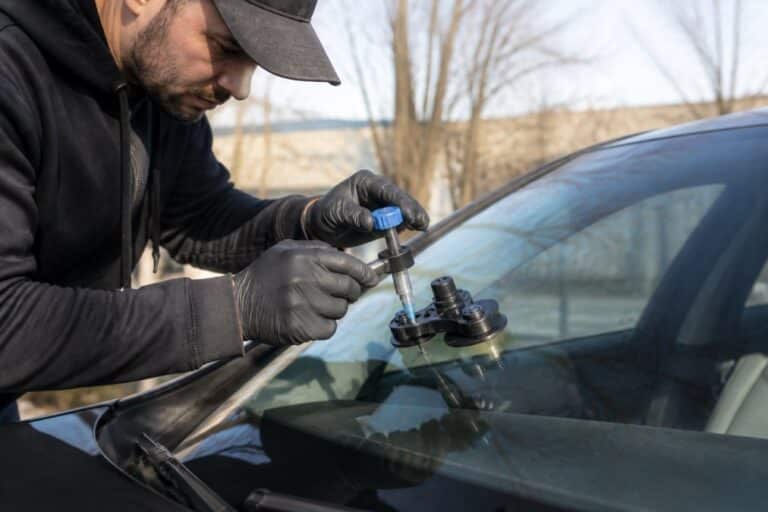
Table of Contents
- Why a Small Chip Is a Bigger Problem Than It Looks
- 8 Benefits of Professional Windshield Chip Repair
- 1. Restores Structural Integrity
- 2. Maintains Optical Clarity and Visibility
- 3. Stops Chip Spread Before It Becomes a Crack
- 4. Protects Your ADAS Systems
- 5. Preserves Vehicle Resale Value
- 6. Reduces Glass Waste and Environmental Impact
- 7. Long-Term Durability of Professional Resin
- 8. Fast, Convenient, and Cost-Effective
- Windshield Repair vs Replacement Cost: What You Actually Pay
- DIY Windshield Repair Kit Risks You Should Know
- How to Choose a Certified Auto Glass Technician
- What the Professional Windshield Chip Repair Process Looks Like
- Frequently Asked Questions
Last Updated: September 2, 2026
A small chip in your windshield is easy to ignore. At A to Z Auto Glass, we hear this from drivers every week: “It’s just a tiny crack, I’ll deal with it later.” The problem is that “later” has a way of turning a $100 repair into a $600 replacement. Understanding the full benefits of professional windshield chip repair is what separates drivers who stay ahead of the problem from those who end up on the side of the road with a shattered windshield.
This guide covers everything you need to know: why chips spread, when repair beats replacement, what ADAS recalibration means for modern vehicles, and how to spot a certified technician worth trusting.
Why a Small Chip Is a Bigger Problem Than It Looks
The windshield is a structural component of your vehicle. It accounts for a significant portion of the roof’s crush resistance in a rollover and supports airbag deployment by giving the passenger-side bag a rigid surface to push against. A compromised windshield, even one with a small chip, is a weaker windshield.
How Chip Spread Happens
Chip spread happens when thermal stress, road vibration, or moisture contamination causes the initial impact point to propagate outward into a stress crack. Temperature swings are the most common trigger: glass expands in heat and contracts in cold, and that movement works against any existing fracture. Running your defroster on a freezing morning can turn a bullseye break into a star break overnight.
Moisture contamination makes it worse. Once water enters the chip, it weakens the PVB interlayer, the laminated inner layer that holds the glass together, and makes the damage nearly impossible to repair cleanly. According to the Auto Glass Safety Council safety standards, windshield integrity is a critical safety standard, and chips that compromise the laminated glass structure should be addressed promptly by a qualified professional.
Visual Inspection Checklist: Repair or Replace?
Use this checklist before calling a technician. It gives you a realistic starting point, though a professional assessment always takes precedence.
|
Damage Type |
Size |
Location |
Likely Outcome |
|---|---|---|---|
|
Bullseye break |
Under 1 inch |
Away from edges |
Repairable |
|
Star break |
Under 3 inches |
Away from edges |
Often repairable |
|
Combination break |
Under 3 inches |
Away from edges |
Assess in person |
|
Crack (linear) |
Under 6 inches |
Away from driver’s line of sight |
Sometimes repairable |
|
Chip at edge |
Any size |
Within 2 inches of frame |
Usually requires replacement |
|
Chip in driver’s sightline |
Any size |
Center of driver’s view |
Usually requires replacement |
|
Multiple chips |
Any |
Anywhere |
Replacement likely |
If the damage is in the driver’s direct line of sight, replacement is the safer call regardless of size. Optical clarity matters more than convenience.
8 Benefits of Professional Windshield Chip Repair
Professional windshield chip repair delivers measurable advantages over waiting, ignoring the damage, or attempting a DIY fix.
1. Restores Structural Integrity
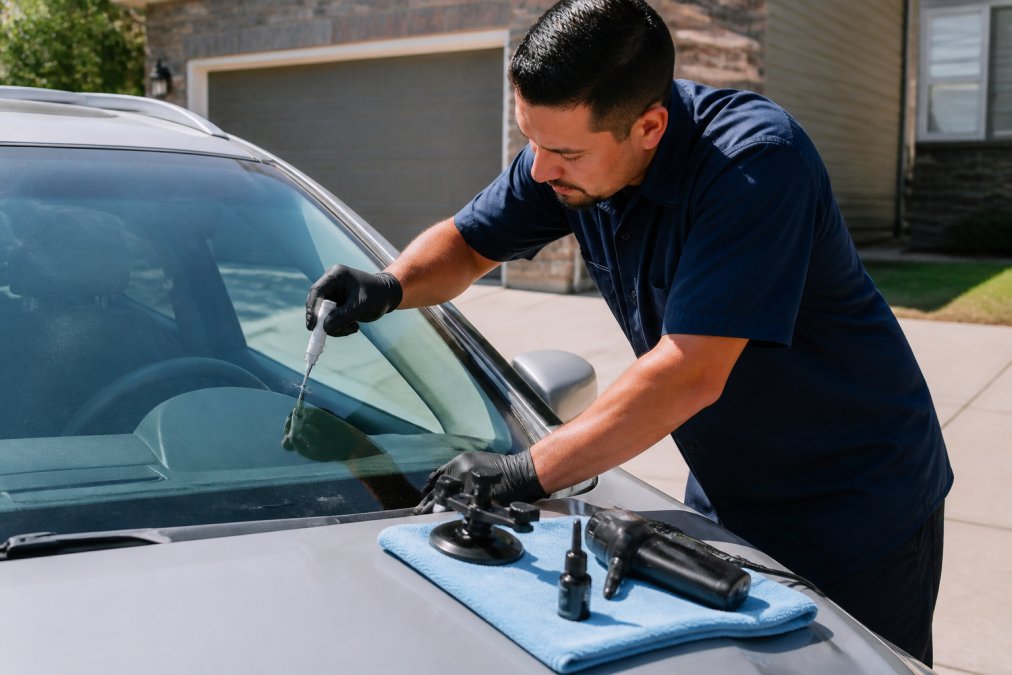
Windshield chip repair restores the structural integrity of the glass by filling the void left by the impact with professional-grade resin. A certified technician uses vacuum injection to remove air and debris from the chip before introducing the resin, which bonds to the surrounding glass and cures to a hardness that closely matches the original laminate.
2. Maintains Optical Clarity and Visibility
A repaired chip should be nearly invisible to the driver. Professional resin is optically matched to the glass, and UV curing locks in clarity. An unrepaired chip creates a refraction point that scatters light, causing glare at night or in direct sun. Optical clarity is a safety specification, not cosmetic.
3. Stops Chip Spread Before It Becomes a Crack
Stopping chip spread early is the entire economic case for repair. Once the damage extends beyond a certain length or reaches the edge of the glass, repair is no longer viable and full glass replacement becomes the only option. Repair is preventative maintenance: you spend a little now to avoid spending a lot later.
4. Protects Your ADAS Systems
Modern vehicles rely on ADAS, advanced driver assistance systems, that include forward collision warning, lane departure alerts, automatic emergency braking, and adaptive cruise control. Many of these systems use cameras and sensors mounted directly to the windshield. A chip in or near that mounting zone can interfere with sensor accuracy.
If a chip leads to full glass replacement, ADAS recalibration is required after the new windshield is installed. Recalibration ensures the camera’s field of view is correctly aligned to the vehicle’s centerline. Skipping this step can cause the system to misread lane markings or fail to detect obstacles at the correct distance. The National Highway Traffic Safety Administration guidance on ADAS underscores that these systems must function within manufacturer specifications. Repairing a chip before it requires replacement sidesteps the recalibration requirement entirely.
5. Preserves Vehicle Resale Value
A chipped or cracked windshield is an immediate red flag during a vehicle inspection or private sale. A professionally repaired chip is nearly invisible and does not appear as a defect on most vehicle history assessments, preserving the vehicle’s presented condition and resale value.
6. Reduces Glass Waste and Environmental Impact
A full windshield replacement generates significant glass waste. Automotive glass is laminated, and the PVB interlayer makes it difficult to recycle through standard streams, often ending up in landfill. Repairing a chip instead of replacing the entire windshield eliminates that waste entirely.
7. Long-Term Durability of Professional Resin
Professional-grade resin, properly injected and UV-cured, bonds permanently to the glass. The repair does not “wear out” under normal driving conditions. A properly executed windshield chip repair should last the remaining life of the vehicle without reopening or spreading.
8. Fast, Convenient, and Cost-Effective
Most professional windshield chip repairs take 30 to 45 minutes, compared to 60 to 90 minutes for full glass replacement. Repair is significantly less expensive than replacement, and many comprehensive coverage policies cover chip repair with no deductible, meaning the out-of-pocket cost to the driver can be zero.
Windshield Repair vs Replacement Cost: What You Actually Pay
Windshield repair vs replacement cost varies based on vehicle type, glass complexity, and whether ADAS recalibration is required.
|
Service |
Typical Scope |
Insurance Coverage |
ADAS Recalibration Needed? |
|---|---|---|---|
|
Chip repair |
Single chip, qualifying damage |
Often covered, no deductible |
No |
|
Crack repair |
Short linear crack |
Sometimes covered |
No |
|
Full replacement |
Damage beyond repair criteria |
Covered under comprehensive |
Yes, if ADAS-equipped |
For specific pricing, contact A to Z Auto Glass directly for a transparent quote. Pricing depends on your vehicle’s year, make, model, and glass specifications. Many drivers with comprehensive coverage pay nothing out of pocket for chip repair. Check your policy before assuming you’ll pay the full cost. The Insurance Information Institute guide to auto glass coverage explains how comprehensive coverage typically handles glass claims.
DIY Windshield Repair Kit Risks You Should Know
DIY windshield repair kits are widely available and inexpensive, but they are often the wrong tool for the job. Consumer kits use lower-viscosity resin that does not fill the chip as completely as professional-grade material, and the injection mechanism lacks the vacuum pressure needed to remove air and debris. The result is often a repair that looks acceptable initially but shows bubbling, cloudiness, or discoloration within months.
A failed DIY repair can complicate a professional repair. Once resin has been introduced to the chip, a technician must work around it, and contamination can make a clean professional repair impossible, forcing a replacement that could have been avoided. For chips that qualify for repair, the professional process costs more than a kit but delivers a result that actually lasts.
How to Choose a Certified Auto Glass Technician
The quality of a windshield chip repair depends almost entirely on the technician performing it.
Certification: The Auto Glass Safety Council (AGSC) offers technician certification that covers installation standards, safety protocols, and materials handling.
Experience: Ask how long the technician has been performing repairs specifically, not just working in auto glass generally.
Mobile service capability: A technician who comes to your location eliminates the risk of driving on a compromised windshield and ensures the repair happens in a controlled environment.
Transparent pricing: A reputable technician provides a clear price before starting work.
Warranty: Professional repairs should come with a warranty against the repair failing or the chip spreading from the repaired point.
A to Z Auto Glass has provided mobile windshield repair and replacement services for 25 years, with technicians who bring the tools and expertise directly to your home or workplace.
What the Professional Windshield Chip Repair Process Looks Like
The professional windshield chip repair process is straightforward, but each step matters.
Step 1: Inspection The technician examines the damage to confirm it qualifies for repair, checking size, location, depth, and moisture contamination.
Step 2: Debris Removal Any loose glass fragments, dirt, or debris are removed from the impact point. This is critical; any contamination left in the chip will be sealed in by the resin.
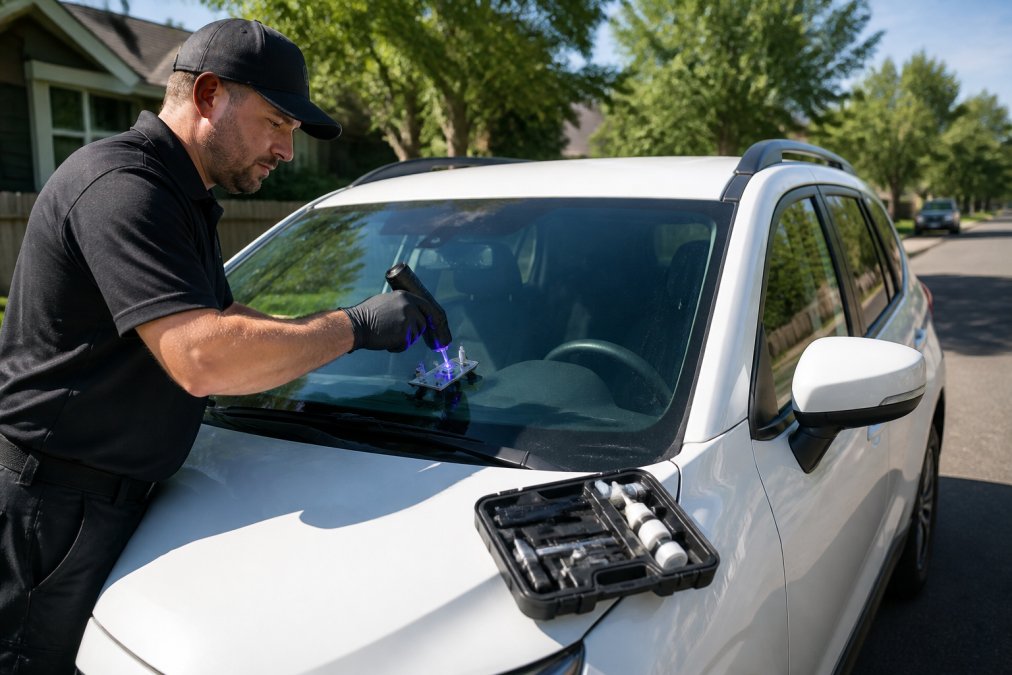
Step 3: Vacuum Injection A bridge device is positioned over the chip and a vacuum is applied to draw out air. Professional-grade resin is then injected under pressure, filling the chip completely.
Step 4: UV Light Curing The resin is exposed to UV light, which triggers the curing process and hardens the material to its final state.
Step 5: Surface Finishing Any excess resin is removed and the surface is polished. A properly finished repair should be smooth to the touch and nearly invisible from the driver’s seat.
As documented in AGSC installation and repair standards, proper resin injection and curing procedures are essential to achieving a repair that meets safety specifications.
Driving with an unrepaired chip is a risk most people underestimate until the crack runs across the glass on a cold morning. The benefits of professional windshield chip repair go well beyond cosmetics: structural integrity, optical clarity, ADAS protection, and resale value are all at stake. A to Z Auto Glass offers mobile repair and replacement with 25 years of experience, transparent pricing, and no shop wait times. Schedule your repair at home or at work, and get back on the road with a windshield that’s actually road-ready.
Frequently Asked Questions
Do windshield chip repairs actually work?
Yes, professional windshield chip repair works well when the damage is addressed promptly and meets the right criteria. A certified technician injects high-grade windshield resin into the impact point using vacuum injection, then cures it with UV light. This bonds the laminated glass layers, restores structural integrity, and significantly improves optical clarity. Results depend on chip size, type (bullseye, star break, combination break), and whether moisture contamination has set in. Chips treated early consistently produce better, more durable outcomes.
Is it better to repair a windshield chip or replace the entire glass?
Repair is almost always the better first option for chips smaller than a quarter and cracks shorter than roughly 12 inches, provided they are not in the driver’s direct line of sight and have not spread to the glass edge. Professional windshield chip repair costs far less than full glass replacement, takes under an hour, and preserves the original factory seal. Replacement becomes necessary when the damage is too large, affects the PVB interlayer, or compromises ADAS camera calibration zones.
Will windshield chip repair affect my insurance premium?
Filing a windshield chip repair claim under comprehensive coverage typically does not raise your premium because it is a no-fault claim. Many insurers waive the deductible entirely for repairs since the repair cost is far lower than a full replacement. Check your specific policy terms, but most drivers find that using comprehensive coverage for windshield chip repair is cost-effective with no penalty. Confirming deductible details with your insurer before scheduling is always a good step.
How long does a professional windshield chip repair take?
Most professional windshield chip repairs take 30 to 45 minutes from start to finish. The technician cleans debris from the impact point, applies the resin via vacuum injection, and completes the UV light curing process on-site. With mobile service, there is no shop wait time. Driving restrictions after repair are minimal — typically just enough time for the resin to fully cure, which the technician will confirm before you leave.
This article was written using GrandRanker